



Exercises to Improve Coordination and Agility

Coordination and agility are essential components of physical fitness that extend far beyond athletic performance. While raw strength and endurance provide the power and stamina needed for physical output, coordination and agility dictate how efficiently, accurately, and safely the body moves through space. Athletic endeavors like basketball, soccer, tennis, and martial arts depend on quick directional shifts and precise body control. Similarly, daily activities like navigating uneven terrain, reacting to sudden obstacles, and maintaining balance as the body ages rely heavily on these motor skills.
Developing coordination and agility requires training the neuromuscular system—the communication pathway between the brain, nerves, and muscles. Rather than simply isolating single muscle groups, coordination and agility drills challenge spatial awareness, balance, reaction time, and multi-directional footwork. Incorporating dedicated agility and coordination exercises into a weekly fitness program sharpens cognitive processing, refines movement mechanics, and protects against common fall-related injuries.
Understanding Neuromuscular Control, Agility, and Coordination
To design an effective training program, it helps to understand the distinct motor skills involved in dynamic movement.
-
Coordination: The ability to execute smooth, accurate, and controlled movements by synchronizing multiple body parts and muscle groups simultaneously. It relies heavily on proprioception—the sensory perception of joint position and spatial orientation.
-
Agility: The physical capacity to change velocity, direction, or movement patterns rapidly in response to an external stimulus without losing balance or control. True agility involves both physical mechanics and rapid cognitive processing.
-
Reaction Time: The speed at which the nervous system perceives a visual, auditory, or tactile signal and initiates an appropriate physical response.
Training these attributes requires novel, complex, and high-velocity movement patterns that force the nervous system to adapt, build new neural pathways, and recruit muscle fibers efficiently.
Essential Ladder Drills for Foot Speed and Spatial Awareness
Agility ladders are among the most effective tools for developing rapid footwork, rhythm, and lower-body coordination. Ladder drills teach the brain to send rapid signals to the lower extremities, improving foot placement accuracy and light-footedness.
High-Knee Single-Foot Runs
Place an agility ladder flat on the ground. Begin at one end and run through the ladder, placing one foot inside each rung sequentially. Drive your knees up to hip height while pumping your arms in synchronization with your legs. Maintain an upright posture and focus on light, quiet foot contacts on the balls of your feet.
In-and-Out Shuffle
Stand at the side of the first ladder square. Step your lead foot into the square, followed immediately by your trailing foot. Step your lead foot back out to the opposite side of the ladder, followed by your trailing foot, while advancing forward to the next rung. This rapid lateral and diagonal shuffling motion trains quick hip transitions and multi-directional foot awareness.
Ickey Shuffle
Start standing to the left side of the first square. Step your right foot sideways into the first square, bring your left foot into the square beside it, and then step your right foot outside to the right of the second square. Step your left foot into the second square, follow with your right, and step your left foot outside to the left of the third square. Continue this fluid, three-step rhythm along the full length of the ladder.
Cone Drills for Multi-Planar Directional Changes
Cone drills challenge your ability to decelerate, plant your feet securely, reorient your center of mass, and accelerate in a new direction. These exercises strengthen the ankles, knees, and hips while conditioning the body to absorb and re-apply kinetic forces.
The 5-10-5 Pro Agility Shuttle
Set three cones in a straight line, five yards apart from each other. Start at the center cone in a three-point stance. Sprint five yards to the right, touch the line or cone base with your right hand, plant your outside foot, pivot, and sprint ten yards to the far left. Touch the far left line with your left hand, plant, and sprint back five yards through the center finish line.
The T-Drill
Set four cones in a T-shape. Place Cone A at the base, Cone B ten yards directly ahead, Cone C five yards to the left of Cone B, and Cone D five yards to the right of Cone B. Start at Cone A and sprint forward to Cone B, touching its base. Shuffle laterally five yards to the left to touch Cone C, shuffle ten yards laterally to the far right to touch Cone D, shuffle five yards back left to Cone B, and backpedal ten yards back through Cone A.
Box Drill with Variable Movements
Arrange four cones in a ten-yard by ten-yard square. Start at Cone 1, sprint forward to Cone 2, shuffle laterally to Cone 3, backpedal to Cone 4, and perform side-steps or crossover strides back to Cone 1. Vary the movement patterns each cycle to keep your nervous system challenged.
Unilateral and Dynamic Balance Exercises
Balance provides the foundation for both coordination and agility. Unilateral exercises force the stabilizing muscles around the feet, ankles, knees, and hips to work continuously to keep the body upright during dynamic movement.
-
Single-Leg Hops to Stick Landing: Stand on one leg, sink into a quarter-squat, and hop forward or laterally onto the opposite leg. Land softly on the ball of your foot, sinking into your hip and knee to absorb force, and hold the landing completely still for two full seconds before hopping again. This drill conditions joint stability and eccentric braking force.
-
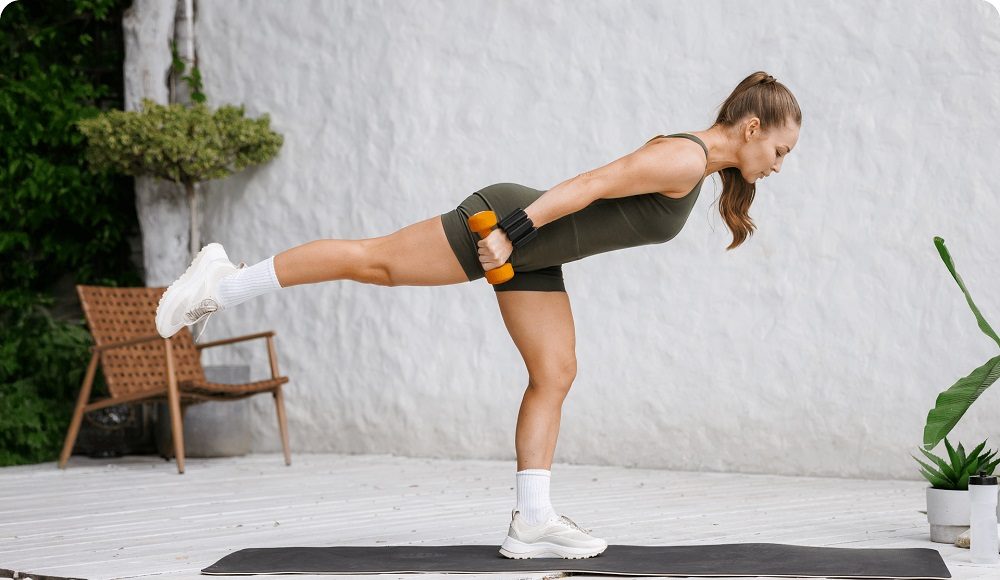
Bosu Ball Single-Leg Reaches: Stand on the flexible dome of a Bosu ball on one leg. Slowly reach your non-standing leg forward, sideways, and backward without touching the floor, maintaining control through your core and ankle.
-
Clockwork Cone Reaches: Place four small cones or markers on the floor around you at twelve, three, six, and nine o’clock positions. Balance on one leg in the center and reach down to touch each cone sequentially with your hand or opposite foot, bending deeply at the hip and knee while maintaining balance.
Plyometric and Rotational Power Exercises
Agility requires explosive force application. Plyometric exercises train the stretch-shortening cycle of tendons and muscle fibers, allowing the body to absorb elastic energy rapidly and release it explosively.
Lateral Skater Jumps
Stand on your right leg with your left foot elevated behind you. Push off explosively with your right foot, jumping laterally to the left. Land softly on your left foot while sweeping your right leg behind you in a speed-skater motion. Immediately push off your left leg to jump back to the right, keeping the movement fluid, continuous, and wide.
Reactive Medicine Ball Rotational Throws
Stand three to five feet away from a solid concrete wall holding a weighted medicine ball. Rotate your hips and torso back, then explosively drive your hips forward, throwing the ball against the wall with full rotational force. Catch the ball on the rebound, absorb the force through your core and hips, and immediately initiate the next throw.
Integrating Reaction and Cognitive Drills
Physical mechanics alone do not account for true agility; real-world scenarios require reacting to unpredictable visual or auditory cues. Adding cognitive elements converts simple movement patterns into true agility drills.
-
Partner Reaction Sprints: Stand facing a partner who holds two different colored balls or cones. When the partner drops one item unexpectedly or calls out a specific color, react instantly by sprinting in the designated direction.
-
Mirror Drills: Face a partner standing three yards away within a designated boundary. As the partner moves unpredictably side-to-side, backpedals, or drops into squats, react instantly to mirror their movements precisely without breaking rhythm.
-
Number and Color Callout Drills: Set up four colored cones in a semi-circle around you. Have a partner call out random color sequences or simple math equations whose answers correspond to specific numbered cones. React, sprint to touch the correct cone, and return to the center.
Frequently Asked Questions
What is the difference between speed and agility?
Speed refers purely to how fast an individual can move in a single, straight line from point A to point B. Agility incorporates directional changes, deceleration, acceleration, spatial control, and cognitive reaction times to changing external stimuli.
How many times a week should I perform coordination and agility drills?
Performing agility and coordination drills two to three times per week provides optimal stimulus for neuromuscular adaptation. Because these drills demand high neurological focus, perform them when fresh, ideally at the beginning of a workout session after a thorough dynamic warm-up.
Can older adults benefit from agility and coordination training?
Yes, coordination and agility training are exceptionally beneficial for older adults. Tailored agility drills improve balance, joint proprioception, cognitive processing speed, and foot placement, which significantly reduces the risk of dangerous stumbles and falls in everyday life.
Why should agility drills be performed early in a workout routine?
Agility and footwork drills require a fresh central nervous system to execute precise, high-velocity motor patterns. Performing these drills when fatigued leads to sloppy footwork, reduced movement speed, altered biomechanics, and increased risk of acute ankle or knee sprains.
What equipment do I need to start training for better agility?
You can build exceptional agility with minimal equipment. An agility ladder, four to six training cones, and open space are all that you need to complete a wide variety of high-yield footwork, shuttle, and reaction drills.
How do agility exercises help prevent sports injuries?
Agility exercises strengthen stabilizing muscles, ligaments, and tendons around vulnerable joints like the knees and ankles. They condition the body to absorb deceleration forces safely, plant feet with proper mechanics, and maintain joint alignment during sudden cuts, reducing the likelihood of non-contact ligament tears.
How long does it take to see improvements in foot speed and coordination?
With consistent training two to three times per week, most individuals notice improvements in spatial awareness, rhythm, and foot placement accuracy within three to four weeks. Significant improvements in reaction time, cutting speed, and complex body control typically develop over eight to twelve weeks.